

This is a critical article about Colombian food. To see a positive article about the Colombian dishes I miss, see 10 Things to Eat in Bogota.
I didn’t understand what “bad food” meant until I moved to Colombia. Bad food doesn’t mean unpleasant flavors. It means NO flavor. It means flavorless food at every meal, meal after meal, day after day. It means meals aren’t a part of the day to look forward to.
This is something that Colombians are becoming increasingly aware (and sensitive) about in regards to their country. I’m not the only guy saying it. All the expats in Colombia gripe about it when they get together. It’s unanimous.
Below are the main reasons why eating in Colombia every day is No Fun.
ACPM
 Photo credit: MasterChef Colombia
Above is a version of ACPM, the most typical meal in Colombia, except the beef would neither be that thick nor so free of fat and gristle … that was the MasterChef’s touch. I also had to Photoshop out (actually I use Paint) a little ramekin of sauce he had on the plate. You’d never get that with your ACPM in Colombia, it’s FAKE NEWS!
ACPM is what Colombians say to describe what they want in a plate: arroz, carne, papa, maduro – rice, meat, potato, fried plantain. The rice is white, cooked without garlic. The meat is bare, maybe a little salt. The potato is unpeeled and dusted with salt. The plantain is fried. It’s a utilitarian plate, and with a little variation this is what you eat in Colombia every day (mix and match arepas, yuca and patacones for the potatoes and banana, but always white, garlic-free rice).
This is what makes eating in Colombia so bad — the monotony instead of variety and lack of flavor in the few items you eat every day. That’s why everybody drools over the juices in Colombia. The juices are the same throughout the continent, but in Colombia the juice was the best part of the meal!
After eating ACPM every day, I started thinking about why I was suffering. Why is Colombian food so bad? What could make it better? I came to experiment in my own cooking more than ever before. In the end, I realized that I have to THANK Colombia for teaching me to learn and love food … by taking good food away.
I had lived in the United States and Peru, where there is more variety and flavor than you can handle. You can eat good food every day without really trying. You take it for granted.
But in Colombia, I had to focus. Strategize. Learn. In hindsight I ought to thank Colombia. I owe Colombia for starting the process of my becoming a foodie, which was borne out of necessity given the lack of good food there.
Arepas

See my article on the most frequently suffered Colombian staple, the arepa.
The most damning case is made by the arepa experience an American expat told me. He went out of town. The day of his flight, he and his girlfriend were running late. They didn’t have time to eat the meals their empleada prepared for them. They left them on the kitchen table as they ran out the door to catch their flight. When they returned a week later, they found that ants had eaten every morsel of food on each plate – except the arepas. In fact, the arepas were completely intact. Two whole arepas remained, and nothing else.
After hearing this story I extended the logic to gringo expats and tourists in Bogota with a riddle. If you threw this arepa out in the street (instead of the trash as you usually would), who would eat it first? Let them guess a few times.
Dogs won’t eat them (I’ve tried). Ants won’t either, according to the anecdote. I doubt a horse would, but horses don’t pass very frequently (but they do).
Answer: a HUMAN. One of the thousands of bazuceros / indigentes / vagrants that prowl the streets would be the first (and only) living thing to eat your discarded arepa.
Patacones

While I don’t like the other items on this list, I can at least finish them if I try. Patacones, on the other hand, are often so dry, hard, and flavorless that I can’t get them down even if I want to. Colombians lay a little salt on them, but that’s not enough for me. I’ve tried lime juice to no avail. Avocado / guacamole are the best bet. Better to just leave the patacon alone.
Here’s my true story to illustrate how awful patacones are. When entertaining tourists in Bogota, I’ll always bring them to one of the black folks’ fish houses (“pescado pacifico” in Spanish). While the standard black folks’ fish plate is one of the best things to eat in Colombia, it will unfortunately come with a patacon disk.
When the gringo tourist tried to eat the patacon, I tell him it’s not supposed to be eaten. Its purpose is for safety. In case a fish bone gets lodged in your throat and you begin to choke, you’re supposed to bite off a piece of patacon and chew, which in turn will cause a gag reflex and you’ll cough up the fish bone. They serve it with every plate out of part safety, part superstition.
Do you live in Colombia? When you bring tourists to eat fish, tell them this with a straight face. You’ll be amazed at the number of people who believe you. And even if they don’t, they won’t eat the patacon.
Panela

Panela is evaporated sugar cane “juice” sold in brick form by the penny. Two bits buys ten pounds.
“Brick” isn’t an exaggeration. You can’t cut panela with a knife. Colombians use a special rod or the blunt side of a big knife to hit the panela brick until it cracks. You break off smaller rocks of condensed sugar solids that are sticky in your hands. It needs to be melted down, usually done in water/juice (agua de panela), the milk of arroz con leche, or directly in the mouth. It’s common to eat panela in cube form, as if a large, condensed sugar cube.
The toxicity of sugar aside, panela wouldn’t bother me so much if people didn’t make the claim that it’s healthy. Not only Colombians, I’ve heard gringos claim that it’s “natural” and has vitamins. I’m going to set the record straight for you . Remember this forever:
Panela is to sugar cane as corn syrup is to corn.
Easy to remember, and it will help you look past the pretty name. Before you make a health claim about panela, first test the statement by substituting the words, “high fructose corn syrup.” For example, if you wouldn’t say “high fructose corn syrup has essential vitamins and minerals” or “high fructose corn syrup is good for you because it’s natural,” then don’t say it about panela.
One thing they say which is true and passes the corn syrup test: panela is good for energy. As is honey, molasses, Coca-Cola, Hershey’s chocolate syrup, Snickers bars, etc.
Buñuelos and Pandebono

There are many interesting customs for breakfast in Colombia. Hot chocolate with cheese in it is great in my opinion.
But these flavorless balls of bread with the texture of play-dough are not great. Buñuelos are fried; pandebono baked. Both are always light on cheese, heavy on starch, void of flavor. The best description is maybe a glazed donut with no glaze, no sugar. Just plain.
I’ve seen groups of Colombians — professionals in a corporate headquarters up north — get all excited when a box of these got brought in. They were rubbing their hands together in anticipation of eating the plain donut balls. ¡NO GRACIAS!
Tamales

Tamales are often held up as an example of delicious Colombian cuisine. I would only suffer my way through one if I was flat broke. Tamales are great if you need to fill your belly for 4000 pesos. Or maybe with several years in Colombia and your taste buds have come to resist bold flavors.
Peruvian and Mexican tamales are better because neither uses rice. No extra filler crap. But given how utilitarian Colombians are in the kitchen, they use rice.
The Tolimense tamales that have beef or pork inside are actually not bad — almost “good.” But most Colombian tamales you eat will have a chicken thigh inside a mold of rice and cornmeal. Minimal cost, minimum flavor, miserable living.
Colombian Soups

Colombians are proud of their soups, which I can only explain by thinking most have never left Colombia. Whenever you’ve cornered them about how there is so much flavorless foods and the few good items aren’t really that good, they’ll throw out their soups.
And I assume they’ve never been outside Colombia, never tasted chili, gumbo, clam chowder, beer cheese coup, French onion soup, minestrone, or the Arequipan heavyweights, chupe de camarones and adobo.
Colombians can be proud of Ajiaco and Sancocho in my opinion. I liked Ajiaco when it was cold and rainy in Bogota, but it’s not good enough to make the menus of the hip “Nuevo Latino” restaurants in the States.
And my Peruvian wife actually spit out the Sancocho I prepared one night when she tasted the banana. Then she called her mother to tell her that I had made a soup with banana in it! She added that this soup was from Colombia, which most Latin American women equate with cocaine and hookers. They wonder if there is something wrong with me. Does it mean I’m going to leave her for Colombia? Then they hang up and the mother calls her sisters to tell them that I made soup with banana in it. I really don’t think it’s that bad.
I know many gringo expats disagree, but I think Colombian changua is interesting. And Caldo de Costilla, yeah sure because there’s nothing else with protein for breakfast worth eating, you know?
Unfortunately Ajiaco, Sancocho, Changua and Caldo combined don’t make Colombia’s soups as a whole “good.” They are OK before being dragged down by the much more common soups you get with your daily lunch.
For this the Colombians go really bland, with stuff like sopa de arroz. You read that correctly: RICE SOUP. Pictured above but imagine it without the cilantro leaf or any morsel of chicken. Others include PASTA SOUP, but the worst is PLANTAIN SOUP. It’s not bad because it has banana in it, it doesn’t. It has some kind of green leaves, which I assume are plantain tree leaves.
So when you consider them all, Colombian soups are not average. They FAIL.
Colombian Ceviche

Peruvian ceviche is my favorite plate in the entire world. Better than anything American, Italian, Mexican, Indian, Arequipan – anything.
Colombian ceviche is shrimp in ketchup with lime and onion, served with saltine crackers. What you see above is served with saltines. Shrimp. Ketchup. Lime. Onion. Crackers. ¿Donde es el restaurante peruano, por favor?
Colombian Hot Dogs

The Colombian hot dog is the worst imitation of American cuisine I’ve seen in all the world. The problem is there’s about 1/8 pound hot dog which would never be all beef. It’s put in a one-pound hot dog bun and topped with another pound of sauces: ketchup, mustard, mayo, “rosado” (ketchup mixed with mayo), pineapple sauce, fried onion crisps. In this image it’s topped with a quail egg, which is actually an improvement.
The result is a hint of hot dog with a couple pounds of bread and condiments. This wouldn’t bother you much if it were like the hard-to-find Colombian ceviche — see no evil, taste no evil. But the Colombian hot dog comprises 90% of what’s available late night. Every gringo rumbero in Colombia has suffered one of these.
Colombian Ketchup
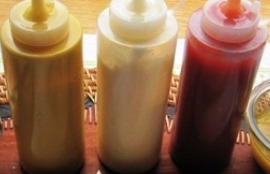
You’re thinking, “Come on, Colin, you’re going to criticize the ketchup?” Yes, I have to, it’s indicative! It shows you what you’re dealing with here!
In most of Latin America, “ketchup” is translated to “ketchup” in Spanish. In Colombia, however, they ironically use “salsa de tomate.” It’s ironic because in most Colombian eateries, what is presented as ketchup and even served in a red bottle contains no tomato. It’s red, it’s the texture of ketchup, and it’s a little sweet … but no tomato whatsoever. You have to taste it to understand.
In Cartagena all the ceviche vendors had their ketchup bottles prominently displayed. I realized the idea was to show off their name-brand ketchup – Fruco, San Jorge, Pampero – these guys are showing off their authentic ketchup bonafides as opposed to the false ketchup commonly found in Colombia.
I didn’t know which is worse, that Colombian ceviche uses ketchup or that they proudly display their brand-name ketchup to show off that it’s not fake ketchup.
The fake ketchup industry in Colombia – that’s an investigative article I’d like to read. But before we get ahead of ourselves, what kind of country would have a fake ketchup industry? What is so fucking expensive about ketchup that you have to falsify it? And ketchup is not that great to begin with — only for burgers, dogs and fries — so any false ketchup would taste so bad that nobody would eat it, right?
WRONG.
Because Colombian food sucks …
… and Colombians don’t seem to mind.
Good Colombian Food?
Again, this is a critical article about Colombian food. To see a positive article about the Colombian dishes I miss, see 10 Things to Eat in Bogota.
Before you leave a comment telling me why I’m wrong, please read through some of the comments. You may be surprised how many foreigners in Colombia agree with me, which is why this is the most popular article on this blog.
Interesting article that will infuriate most Colombians. Even though this guy is clearly biased (since his wife is peruvian), most people would agree that Colombian food is simple. And, to be honest, I only like the Colombian food my mom or my grandma makes. Food from random places in Bogotá is really just stomach filler 98% of the time, and that’s probably what this guy experienced.
True! Bogotá cannot be the Colombian food example. to start not all Colombia puts rice in The tamal, I am Colombian and I hate tamales with rice. I don’t like Bogota’s arepas and they are not the experts of pandebono. Restaurant food In Colombia is not the best because of how cheap they sell it; they have to use more fillers. So let’s not generalized, Bogota is not the true Colombian food.
Granted. Colombian food lacks spices, in general but naaaa, he is simply a very opinionated idiot borderline racist. Probably he went to the worst restaurants and got the worst version of evey dish. Narrowed minded a-hole, that`s what he is.
Wow someone is hurt. I agree with most sentiment shared in the post. Boring food
No Julio, it’s called objectivity. Furthermore, opinions are subjective by nature and as such can not be considered wrong, only in agreement or opposition. Sorry to pull the legs out from your argument but it simply does hold water. The really interesting part is when you mentioned narrow minded, hello, pot-kettle-black.
Talk about no sense of awareness. Have a fantastic day!!
“dont like Columbian food?! RACIIIIST!”
oh shut up, you imbecilic radical doofus
the true should not hurt , venezuelan and colombian food sucks , reason why all of them u will find them eating at either Cuban or mexican places here in south florida…venezueland and colombian food is hands down the worst from south american ……bland non taste crappy dishes …..no taste , no seasoning ….pretty bad if u ask any other hispanic …..lets put it this way , where is in south florida an Aunthentic Venezueland Restaurant or colombian and why are they often empty
I am not sure what restaurants you are eating at or who is preparing your Colombian food, but I can tell you they’re not doing it right. I am from the coast and yes, I agree the food and regions like Bogota is extremely bland. But not all Colombian food or Colombian cooks are the same.
Colombian food went down right it is incredibly delicious.
I hope one day you get to experience true Colombian food. especially from the Arabian, which is an incredible blend of Spanish, African, indigenous Colombia and Arab flavors.
Im in NYC. Any time I wat Colombian food I hate it. Bland and starchy. Find me something tasty. Sorry but that is my opinion.
the comment about Peruvians thinking Colombia = cocaine and hookers..as though there aren’t plenty of both in Peru..
I agree with most of your assessment, Colin. In particular, Colombian (or Venezuelan) tamales are just awful as well as their version of a hot dog. I can handle arepas, patacones, and the soups as long as I add some “salsa picante”.
Interesting article, I can say that the United States does contain more diversity in tems of food, I took my in laws to New Orleans and some of the places around here to try the diversity of food and they enjoyed it. One thing to remember with American food is a do have many tasty dishes but artificial, and when I mean artificial I am referring to the heavily genetically modified veggies and grain fed beef, so this is a huge concern but in terms of variety there is more here.
In colombia I won’t lie, I have had my share of foods I could not stomach like yucca and arepa were very difficult for me, however I have been to a lot of very delicious colombian restaurants as well, and my mother in law is a fantastic cook as well as my wife, I think you will find a lot more variety in the north, it seems that there is a specific style like in Cartagena and Barranquilla. I’ve also been to some very popular colombian restaurants in the us in Houston and in New Orleans which actually made me like arepas. Mai’s arepas in New Orleans was fantastic and a lot of flavor, or arepa with stuffed eggs and meat, but otherwise eating them raw starts my gag reflex just like eating tortilla raw.
I thought it was ironic you listed the colombian hotdog, I was confused the first time I ate one and I couldn’t finish it, just not my style, ajiaco though I am gonna have to disagree, I’ve had some fantastic ajiaco and maybe it’s because I grew up with matzo ball soup that I absolutely love ajiaco.
Also forgot to mention brasa roja, absolutely delicious colombian style chicken, I love those chicken places around bogota and acattered outside the city.
In Colombia you never find good food in restaurants. Corrientazos are the worst examples of Colombian food. Good Colombian cuisine is homemade.
I have to agree, after living in Colombia for about 1 1/2 years I can honestly say Colombian food is horrible. I used to take my girlfriends grocery shopping with me but not any more. I will do my own shopping and cooking. As far as the restaurants, almost all of them suck, even the “foreign” food restaurants. I thought is was impossible to mess up Mexican food but Colombians can mess it up thoroughly.
I have eaten at many Colombian Restaurant from 0-10 . ( I guess) the food doesn’t seem to be seasoned right .. Even when I go to Italian places ..It doesn’t taste right. there are ingredients missing.. I’m a great cook of many types of foods.. My friends will consign on that .. But the food is lacking here.. Things just seem watered down.. I cook my Colombia girl friends Dishes and they go crazy! But I spend lots of time locating seasonings.. Still have trouble locating Italian sweet sausages..
I agree with some of your opinions, but I don’t agree with calling homeless people “things”. I quote:
One of the thousands of bazuceros / indigentes / vagrants that prowl the streets would be the first (and only) thing to eat your discarded arepa.
you should really get your facts straight and learn about side dishes and real ways to eat colombian food.
just to give you an example, there are six (or more) different types of arepas, and each one of those is eaten in a completely different context from the rest; arepas paisas (the ones you call cardboard or whatever, and that i also hate so much because of that) are eaten strictly with butter, salt and hogao, AT LEAST (seems weird and ignorant that you hardly talk about hogao, being it a fundamental and versatile part of colombian gastronomy.)
it is true that food in BOGOTÁ is conceived specially as a stomach filler, but in the rest of the country the best food is that known for its sweetness and whatnot directed for each and every sweettooth on the planet.
if you’re going to criticize food somewhere, anywhere, you better learn about it first. so you don’t sound just ignorant and ingenuously empirical.
Anybody who thinks Changua is “interesting” but dismisses Ajiaco, is one person I dismiss as a food critic.
That’s Colombian junk food. The same thing can be said about American junk food or any other country’s junk food.
I have a feeling you know nothing about Colombian food. It reminds me of Colombians talking about American food; they’d always tell me how terrible it was and I was always thinking, “you’ve never had any real American food in your entire life.”
Comparing Peruvian cuisine to Colombian is ridiculous, it can’t even hold a candle to Colombian cuisine. And you can’t go by your girlfriend or wife. I’ve met women here who can’t cook worth a damn. I mean think about it, there’s probably a reason no one married them until a foreigner came along ;)
@ Carlos Ro – I had homemade arepas a handful of times during my time in Colombia, and they certainly were better. Of course the variations are also better than the plain white arepas paisas. And you are right that most of my Colombian food experience was in Bogota, although I spent a lot of time in Medellin where I thought the food was worse. Eje Cafetero still worse. Cartagena was good, as was San Andres.
@ AlbyM – Nice to meet another gringos who calls a tamale what it is – AWFUL!
@ Meir Cohen – I don’t understand why it comes off that I don’t like Ajiaco. I love it! It’s one of my items on 10 Things to Eat in Bogota: http://www.expat-chronicles.com/2009/11/10-things-to-eat-in-bogota/.
I guess I need to edit this post to set the record straight on Ajiaco, which I ENJOY.
Anything Colombian in the United States would have to be modified to appeal to consumers who want flavor. That’s why MyColombianRecipes is full of foods you’ll NEVER find in Colombia. They have to be modified for gringos to consider them tasty.
@ Rodney – There’s a Mexican joint in Bogota called El Carnal that isn’t too bad. But what I’ve seen of Colombia’s American, Italian, and Chinese imitations, it’s as you say – they all suck.
@ Johann – I linked to my Arepas article, which described all the common variations. In defense of the arepa, the homemade arepas I had during the years I lived in Bogota were good. But as you know if you’re Colombian, you cannot escape those paisa arepas. They’re everywhere and inescapable.
@ Sergio – Again, I very much enjoy Ajiaco. I’m going to edit this article so that’s clear. And changua is interesting for a gringo, although by the end of my time living in Bogota I was rather faithful to the Caldo de Costilla.
@ Daniel – Colombian junk food would be empanadas, papa rellena, chorizo con arepa, and of course the ever-present American imitations of hamburgers, hot dogs, and pizza by the slice. Arepas, patacones, the corriente soups, and panela, on the other hand, are cooking staples that are impossible to escape for somebody who lives in Colombia.
As far as Colombian cuisine beating Peruvian, I have to respectfully disagree. Here’s something to think about – If you’re right, then why are there so many Peruvian restaurants in the affluent neighborhoods of Bogota and Medellin? Because there aren’t more than two Colombian restaurants in all of Lima, and both primarily sell coffee. Not food.
@ everyone – Thanks for reading and commenting! And stay tuned for a positive article on what Colombians do very well in the kitchen: DESSERTS.
I have had good versions of almost everything written about here (minus the ketchup – I am a Gringo condiment man all the way) but the point is that the majority of any given food on this list is going to be terrible. I have eaten some fantastic Paisa arepas, but most of them taste like cardboard. The average patacon has less flavor than oatmeal and I almost always leave them on my plate in that case to prevent my stomach from feeling too full (ditto for unseasoned yuccas, potatoes, and white rice). I have eaten plenty of good food here, but the average joint serving average food is almost always as Colin describes it here. The aggressive blandness drives me nuts.
Re the comment above about American food: I agree, but most food in America is not very good either. If you don’t know where to go, you are going to eat a lot of bad processed crap. A friend of mine had a Colombian student who went to New York, and ate in a different chain restaurant in Times Square every night. That’s what American food is to that guy, and while I know all sorts of foodie hipsters who would turn their nose up at that sort of thing, there are also plenty of Americans who eat McDonald’s nearly every day and don’t see a problem with it.
I have to say that who wrote this chronic is not coherent, in fact the person who made the chronicle was very rude and used a descriptive language to talk about our food and people. Just let me remind to you that the people that he has denominated “bazucas” they are persons like you and me, I think that this article is full with a lot of lies, by the way if you want to get good food, you have to go and find a good place to do it, obviously all the places aren’t good to eat in this country and other counties. That is commun sense and please don’t forget that some of the food that he has criticized is the same food that he has recommended in the other article e.g Bandeja Paisa that contains arepa :) lol
Try living in China, where half the food is FAKE. Food scandal after food scandal here.
As a Colombian, I completely agree.
My mom almost kicked me out of the house because I once told her arepas tasted like cardboard. Glad I’m not the only one who thinks like that.
I agree with you for certain arepas, tamales and patacones. It all just depends how they are prepared and when they are served. I don’t get panela though.
Colin, with all due respect though, but I almost think that your bad experience with Colombian food was tarnished by your living situation while in Colombia and also that you ate at the wrong places.
If I was like you were…. an English teacher in Bogota living on a measly salary, and had to eat mostly from the ACPM places close to where I live in Candelaria or Chapinero, because that’s what I could afford, then I would also have a bad opinion of the food.
I mean come on…at those places you’re eating the left-overs from 3 days ago….That alone will take the flavor away.
I could take you to several places where meals are prepared properly and with fresh ingredients….and I’m not talking about ritzi restaurants in Zona G, Parque 93.
All foods from all countries have good and bad versions, and I am certain that if you get Colombian food at the right restaurants, prepared properly and fresh….then you would have a different opinion.
As an analogy, Paris, France is the culinary capital of the world…..but when I was studying there for 6 months, and I was a poor student, I definitely ate at some crappy food, because that’s all I could afford.
Similarly….if I was an international exchange student living in the U.S.A and all I could afford to eat was McDonald’s, Burger King, Subway, Dominos, KFC, Taco Bell, Panera, then my opinion of American food would also be totally tarnished.
In addition, the majority of complaints I hear from “Gringos” about Colombian food is that it has no flavor; but come to find out that all these idiots eat in the U.S is Mexican-American food or Thai-American food. If you come to Colombia, and your point of reference is “spicy foods” and then you are trying to compare it with Colombian food, then of course you will be sorely disappointed.
“Spicy”, however, does not directly equate to “flavor”.
I live in the U.S.A and every time I come to Colombia…..all food just has better flavor…..even what you get in supermarkets.
Regarding the point that there are lots of Peruvian restaurants in Bogota, but no Colombian restaurants in Lima. That is a flawed argument to say that Peruvian food is better.
I will say that Peruvian food is great…..or to get more specific….Peruvian ceviche.
However, the restaurants you talk about in Bogota, are high-end places from celebrity Peruvian chefs.
Any high-end Colombian restaurant from famous Colombian chefs like “Leo Cocina y Cava” or “Mercado” or “Tabula” could easily be opened up in Lima.
So really the argument is more about high-end Peruvian chefs being better at internationalizing their food to other countries.
Finally, Colin, although I do believe that you dislike these Colombian foods….at the same time I almost think that the only reason you write these blog posts about Colombian food, is because it gets you a lot of hits and comments….from mostly from Colombians that get offended.
But, I can’t blame you for wanting to get more hits.
@ Andy
I never was and never will be a full-time English teacher. My best months in Bogota, overall, were about 8 million pesos.
My top corrientazo, which any Colombian would tell you was very decent, was El Pinguino on Kr 6 (sometimes called Trv 4) between Cl 51 and 50. I also know some of the better ones near Cl 100 and Kr 15. I have eaten at a good share of nicer Colombian restaurants, from paisa to costeño to llanero.
Colombians use almost no flavors. Go to the spice rack at your corner store. There are three or four bags of options, one is a catch-all mix called salsina, and one is colorey – red food coloring. You’d be lucky to find pepper.
There are way too many Peruvian restaurants in Bogota for all of them to be run by celebrity chefs – several dozen. There aren’t that many famous chefs. In my article on Peruvian food, all those plates (of which only one is ceviche) are available at hundreds if not thousands of eateries in every decent-sized city in Peru. You have to visit Peru and eat on the ground to understand the huge difference between the Colombians and Peruvians in the kitchen. It’s not overstated.
I’ll bet dollars to soles that any Colombian restaurant launched in Lima will have little to nothing on the menu that is traditional Colombian food, but unique creations from a celebrity chef. Just as all the places you mentioned are celebrity restaurants as opposed to traditional dishes.
Your theory about doing this to generate traffic is 50% true. The timing of this article certainly coincided with the <a href="https://www.kickstarter.com/projects/expatchronicles/this-micks-life"Kickstarter campaign for This Mick's Life: Addiction and Underworld from Ireland to Colombia. But another 50% is my sincere desire to get revenge on the country of Colombia for all the shit food I suffered during my time there, the lenteja and arepas and frijol and too many miseries to remember. I want Colombia to know their food sucks, how all the expats complain about it.
However, it isn’t all bad. My next Colombian food article will be about their desserts, which in direct contrast to Peruvians who don’t have a sweet tooth at all, are world-class. And of course there is my 10 Things to Eat in Bogota article, which highlights traditional Colombian plates available at hundreds if not thousands of eateries (as opposed to celebrity chef creations).
But again, you put those items up against the items from the Peruvian food article, and there’s just no contest. It might not even beat the cuisine of Arequipa, a city of just 1 million.
I am going to agree with you on this one Mr. Post. I have traveled throughout 22 of Colombia’s 32 departments over the past ten years and have lived there for two years and I can say that Colombian food doesn’t live anywhere near its potential.
You would think that a country with such a variety of climates, altitudes, fruits, vegetables, herbs and animals they would have world class food and an abundance of variety and creativity. Instead we are given milled corn with salt, butter and mediocre cheese for breakfast; can’t forget that it has to be served stale.
I should write a thesis called “Colombia, the land of milk & honey that no one takes advantage of”
Sancocho isn’t a dish. Let’s call it what it really is:
Sancocho, although one of my favorite meals, is loosely translated to English as “This is what happen to grow in the garden this week. Let’s through it in a pot and call it a meal”.
Comparing Colombian food to Peruvian food is laughable. In the ritziest neighborhoods of downtown Miami there are Peruvian restaurants with lines out the door. One Peruvian chef’s restaurant was so successful in Miami that he had to buy the next two store fronts beside him and tear down the walls in order to cater to the demand. Not one Colombian restaurant has had that kind of mark in this Latin-American metropolis.
…and think. Peru is made up of mainly desert, rocky mountains and dense rain forest. If they can make innovative delicious cuisine then there is no excuse as to why Colombian cuisine is so forgettable.
But I love Colombian food. My wife, who is Colombian, makes fantastic dishes for me (sancocho de bagre, arroz con coco, blood sausage, pan de yuca, patacones con hogao & shredded chicken, grilled capybara, mamona a la llanera). Colombian food only works when the right ingredients are purchased and almost everything must come from a family farm to be delicious. If you buy the ingredients in a store and prepare it here in the U.S. more often than not it won’t be the same or even close to scrumptious.
I really grew to love Colombian food because much of what I ate was healthy, filling and gave me energy which is what food is supposed to do. When you feel energetic after eating a good meal that is when food becomes memorable.
I enjoy your stuff Collin and thank you for sharing your opinions.
Just remember Colin is spelled traditionally with one “L” not two. The two L’s seems to have come about due to the internet and American’s making an abortion of many things they don’t really understand. A Colin started a website complaining about people using two “L’s” to spell his name. Didn’t help when people like General Colin Powell wanted his named pronounced, Colon, like your intestine and Americans started naming their children with surnames like Collins. Some people adamently argue that it is spelled with two “L’s”. My response to them is, “How long has your name been Colin?” This tends to silence those who think they know better.
Real life only understood by a fellow Colin. However I believe the surname predates the discovery of the Americas. General Powell was a great man and the mispronunciation wasn’t his fault. But he did nothing to correct his parents’ mistake. In my book, that inaction was worse than making the case to the United Nations to topple Saddam.
This comment comes at a curious time. For the first time in my life I’ve met a Collin (two Ls). I haven’t grilled him about his parents’ mistake yet. He’s a southerner so I’m imagining illiterate sharecropping stock.
I could add a few more gripes but I’m just happy the name has become cool. It was never cool growing up, even worse being a ginger during the gangsta rap era. Now people prefer unique names. (And I give my children names with no less than a millennium of recorded Christian history).
I grew up in US international schools and no one could pronounce my name properly. I got Colon, Kahlin and Cullen. Hence you can’t mispronounce my children’s names and if I’m not sure how to pronounce someone’s name, I ask them how. I think it considerate.
Colin, in my previous comment I wasn’t even trying to say that Colombian food is better, I was just commenting on the flaw in your arguments. If you’re going to say that Peruvian food is better than Colombian food, then don’t use the argument that “there’s more Peruvian restaurants in Bogota, than there are Colombian restaurants in Lima”, as the support for the argument.
I see no problems in someone just saying, “I like Peruvian food better than X food, because I like that they have great seafood, great ceviche, great spices and great creativity.” And personally I will agree with those statements and say that Peruvian food is great. They have great seafood, ceviche, creativity, and they’ve been very successful at exporting their food, and yes, they probably do have the best cuisine in South America.
I guess also my main complain about expat “mochilero” bloggers criticizing Colombian foods is the flawed arguments that you all use, and that the ones that do it is out of resent.
For one, why even compare Colombian food with Peruvian food in the first place, or some other food. In your case, I think the blog post stems from that you’re married to a Peruvian and you live (lived) in Peru. But then there’s other expats that are from Southern California, or another that lived in Pakistan that make comparisons.
Right there, they’re already making a mistake to criticize starting off on the wrong mind-set and expectations by saying that Colombian food is not spicy like Mexican food, or that when they lived in Pakistan they liked spicy food, and that Colombian food is not spicy, so I don’t like it…blah blah, etc.
I tend to like spicy food as well, so my preferences will probably tend towards Thai or Indian food, rather than Italian food. But that doesn’t mean I don’t like Italian food.
I don’t even know why I get wound up by these mochileros, when Conde Naste Travel (<a href="www.nytimes.com/2008/10/26/travel/26choice.html" , and the New York Times <a href="http://www.nytimes.com/2008/10/26/travel/26choice.html" have good things to say about Colombian cuisine…..and they don’t make apple-to-orange comparisons.
Second, if I was a mochilero, and all I could afford to eat was crappy Colombian junk food everyday then I guess I would feel some resent, but I certainly would on a blog revenge rant, as you say you’ve done in your previous comment addressed to me.
Why would you just eat one type of food every day? Vary it a bit man. It’s not like all Colombians eat only Colombian food every day. That’s why in Bogota there’s such a variety of different foreign food. I love Hamburgers in the U.S, but I only eat them once it a while to vary things. I guess I would have some resentment too if I was a poor student that could had to eat junk American processed food every day, but I certainly would never write a blog post that generalized all American food based on a very specific experience.
Colin, but thanks for at least admitting that 50% of your dislike was for revenge due to suffering from bad picking.
Colin, also above in your article you also used an expat, Chris Albitron’s blog post, where he also used stupid arguments. Here is the quote again:
“Guide books will often talk about the great food options in Bogotá: you can get great Italian, Peruvian, Brazilian, French, etc. Notice a pattern there? None of those options are Colombian. Colombian “cuisine”, if you can call it that, consists of unseasoned meat that is fried, or grilled, to within an inch of charcoal”
Just from reading his blog posts after he posted his initial critique, I can see that he’s also an expat gone on “food revenge”.
Totally irresponsible for him to cherry-pick a quote from a guide book and then use that as some sort of support for his subjective feelings.
For one, the reason that a guide book mentioned only foreign restaurants in Bogota in their write-up, is to make the point that the city has a lot of foreign food options. That is not only to show that Bogota is a cosmopolitan city with a lot of good food options….but also it can be implied that since usually the people that buy guide books about Bogota are foreigners, and usually foreigners like to eat well, then well, then they’ll have a lot of restaurant options in Bogota.
Also, I don’t really don’t believe that this guide-book didn’t have at least 1 good Colombian restaurant to mention in its write up in another paragraph after the quote Chris included?
If it really didn’t, then that’s the crappiest guide book ever written in the history of man-kind. Who writes a guide-book about a country, and not include at least a couple of good local restaurants? The answer is NOBODY.
Rather, what Chris did, was cherry-pick one quote, and then he used it irresponsibly to try to make the argument that because Bogota has a lot of foreign restaurants, and the guide book doesn’t mention Colombian restaurants in the same sentence, then Bogota local food must suck.
# 2 – Chris then generalizes that Colombian food is “unseasoned meat that is fried or grilled….”
Again that is a stupid generalization. There’s so many good Colombian restaurants that are so good and which are NOT as he argues “unseasoned meat” and also are not even meat based. Colombian food is so much more varied than meat.
Plus his generalization is based on such small evidence of his experience of “unseasoned meat”. First off, if Chris’ main complaint is about “unseasoned meat”, then right then and there it is proven that he picked a place with bad cooks that don’t season.
So then really, the true argument that Chris was trying to make was that Colombian cooks suck at seasoning, so then by default all Colombian food sucks?
That just proves how irresponsible these RESENTFUL blog posts from expats can be.
That would be like me going to the USA and only eating McDonald’s hamburgers and then making the blanket statement that all American food is processed meat in a blog post.
I mean just go to this website http://www.vive.in to the “Guia Restaurantes” section, and then select “Colombian” or “Costeno” drop-down, and you can have your pick of great varied Colombian restaurants with eater reviews included (it’s in Spanish though). And these range from modest places that still retain the typical look of Colombian food…..to the more high-end eateries like “Mercado” or “Leo Cocina y Cava”…to the truly molecular gastromy places that deconstruct Colombian food…..like “El Cielo”.
Just to name one….I like “Abasto” in Usaquen or “Donostia” in La Macarena, which get a lot their raw ingredients from the local city food markets… such as Paloquemao food market.
So again, I think Chris Albitron’s blog post is an example of another foreigner that generalizes, when he did not make out an effort to search out the places that serve good Colombian food. Chris Albitron, next time, ask a Colombian which are the good places or do better research, and don’t generalize the cuisine of the whole country based on your bad picking skills and based on your specific food preferences.
Finally, Chris mentions that he went ”to a supermarket and they didn’t sell Pepper”.
Are you f-ing kidding me… that is the support for his argument? And the guy is a journalist….a former Burea Chief and Chief Correspondent?
Maybe they ran out that day, you stupid ass. Of course they sell pepper in Colombia.
That is like me saying that one time I went to a Whole Foods in the U.S.A and they didn’t sell Chicken Cube seasoning, and so American food sucks.
All that I am saying is that there is no need to criticize the cuisine of a country with flawed arguments by people that are starting off from the wrong mind-set and use stupid arguments.
It’s ok to give your preferences, dislikes etc., but to generalize the cuisine of a whole country is just plain wrong.
Every country, even the ones with so-called “bad food reputation”, still have good food to offer. That is why I would never dare generalize the cuisine of another country the way you guys have.
Sorry for the long rant.
Colin, I do like your blog, so keep up the good work. I’m looking forward to the Mick’s book, and I’d like to see you write more about Peru, and economics. You had some good economics / business articles in the past, but I’m guessing those were boring to most of your readers.
I totally agree ! I love the people the music and the scenery but the food is depressing.
I stay in MDE for a few weeks at a time and it gets really depressing not to look forward to meals. It ruins my day very often.
Why so negative!? I love colombian food! Yes those nasty little white bland arepas that most fast food places have are repelling…but arepas de chocolo with cheese are pretty good. I would have to say that arepas rellenas(white arepas but handmade, chicken, mushrooms, cordoniz, queso blanco, etc..) are one of my favorite foods from colombia or anywhere in the world. Nobody really mentioned the sides like aji or salsa rosada, not to mention the intense flavors of the meats and sausages. The steaks are great, lechon(whole roasted pig with rice and spices and veggies tucked under the skin)is incredable, and the morcilla and chorizo are insanely good. Don’t even get me started on the empanadas…
But everytime I go to bogota I stay in the same neighborhood of Kennedy in the Floralia area, so maybe they just do things right there. I almost forgot…the fresh bread from the panaderias is awesome. I take at least 2 bags full of bread home on the flight out(I eat most of this on the airplane). Maybe you should try eating more street food and listening to the locals as to where to eat, and stop complaining about how bad the food is. I am 100% American and I think mcdonalds/anyotherfoodchainornationalrestaurant could learn volumes of knowledge about cooking from Colombians.
Ps…I have workedIin the food and beverage(restaurant) industry for almost 20 years.
I only want say one thing…. you get what you pay for! if you want good food pay for it!
Corrientazo?? what the f#&$ were you thinking?
Hola, ayer estaba con mi novia en el Mall Plaza de Trujillo, en Perú, y casi entro a un restaurante mexicano, pero mi novia me dijo que no sabia que esperar de los platos, que, además, no eran tan baratos. Le dije que pediríamos uno para los dos, algo así como para picar y experimentar. Al final prefirió otro restaurante de Parillas.
Hay cierta reticencia de los peruanos, si yo fuera dueño de ese restaurante mexicano pondría esas chica ofreciendo palitos con piqueos gratis, asi como hacen en las áreas de carnes y embutidos en los supermercados.
Sin embargo al salir del Mall, vi un carrito que ofrecía tacos, los cuales se están extendiendo, he visto inclusive a venezolanos ofreciendo arepas en las calles. ¡ Vaya, en otra oportunidad me comeré un taco para ver como sabe!
I’m with you man…I was in Colombia last summer and the food was absolutely disgusting everywhere I went…never to return!
Agree 100% Columbian( I mean Colombian) food is disgusting …. They have about everything else and not there own food because it’s disgusting! This 3rd world country …oh they don’t like that but if your not why is USaid helping your ass? With tons of money …. A big thank you to US! You claim beautiful women? Haha how about beautiful fake women w/ there ass, boob, face about everything implants! Not known for there natural beauty that’s for sure and the men are gross too, short!
Well, I can go on and on but yes the food had no flavor at all and its gross PERIOD!
The commenter above me is very rude. Colombia doesn’t need US aid as much anymore, it’s GDP per captia is about $15,000 USD. How do you know if every Colombian used plastic surgery? Shhh, go to sleep the adults are talking.
Nationalist idiot.
~~~ Anyways, I’m Colombian and I agree that Colombia has one of the worst cusines in South America. However, there are some points that I should talk about.
– I heavily disagree with Colombian hot dogs being terrible. Why are they becoming so popular in Mexico and Central America? There are plenty of stalls in D.F. selling “Perros Calientes Colombianos”. There is so much variety of Hot Dogs in Colombia now, that you can’t hate every kind. My personal favourite is guacamole Hot Dog. Have you tried the Perro Caliente con Hogao? Maybe that doesn’t count as “traditional” colombian food, but it is certainly modern Colombian food.
– According to me and my family, patacones are supposed to be eaten with toppings. If eaten alone, I agree that it is too blande and gross. Maybe it depends what region or household?
– I agree with you about arepas. I dislike arepas and how Colombians are so proud of something so bland and uncreative. We need a national culinary reform!
– I too, hate panela. It’s unhealthy and discusting. We might as well just drink boiled water with sugar.
– Don’t hold a grudge against us. We don’t all cook bad! :)
Finally, although I sadly agree that the majority of Colombian Cuisine is nothing to be proud of, I think that we are a path of changing. More and more Colombians are discovering international ingredients and cooking tecniques. Ceviche style spaghetti and oven roasted salmon with mushrooms are some trending recipies here in Colombia. I may be biased though because I love cooking, but I know eventually Colombian food will get better over time as the populace learns how to cook all over again. Remember that in the 1950’s, the USA was famous for having one of the blandest cuisines. Look in any 1950’s recipie book. Today USA is a cuilnary powerhouse.
Thanks. I hope to see your imput.
I’d like to add that anything that happens in Colombia culturally happens very quickly. Hopefully Colombia will invent a new Colombian cuisine.
Having just spent three weeks in Colombia, we returned home to Canada quite desperate for spinach and anything whole wheat. Eating was a chore in Colombia with the exception of mango mojitos. The coffee is simply a hot beige drink (is Juan Valdez a hoax) that could be confused for tea. The starch load per plate is shocking–and the salt content! I can still feel my veins sticking together. Luckily we had a reprieve at La Sirena, an eco-hotel in Palomino owned by a woman who lived in Toronto for 12 years. Here we found genuine French toast, lentil burgers, black bean burritos and other non-traditional fare. We made a few rounds of guacamole to stretch out the days (punishment) between breakfast and dinner. Ugh. Colombia is right on Cuba’s coat tails with really disappointing food. Despite having such a bounty to work with! Shame. Thanks for this.
Here’s my take on Cuba’s barf-et: https://julestorti.wordpress.com/2012/09/08/dear-lynn-crawford-a-cuban-sos/
I enjoyed this article. Most dishes I had in Colombia were really flavorless. Perhaps I am also biased because I like Indian food and like to eat spicy. Colombia is gorgeous ! But the most popular local cuisine that is just a plate with all these mixed :
brown beans + squashed banana + rice + fried eggs + soft fries + a sausage + dry arepa’s + raw avocado
that really makes me wonder what went wrong in Colombian collective history.
Colombian food is the worztttttttttttttttt .disgustan.
Alejandro, asian-hispanic, a food enthusiast and a social scientist.
I would like to answer the above comments especially the negative ones about Colombia. First and fore most hahaha, hhaha .
It was really intelligent as well as informative though . But anyway, most of the people around the world has different taste buds. These salivary structures in your tongue has different anatomy.
The tongue in each country has a unique taste structures when it comes to flavors. So depending where or what region and country you have eaten your lunch or snack.
Every country represents different food preparations.Be it, the general appearance, taste or so called the “luck of tastiness ” (umami). Further food relies of whatever abundant material, resources, and skills they may have.
This material culture (food) is past down as form of symbolic representations. The so called worst for you, is good for them. Because you are just accustomed differently or you were all been eating your comfort preparations (food)
For many years , the people generally accepts this material culture (food). Now in some cases if try to sell your blue-cheese somewhere in Asia. It will just end in garbage. Because taste-buds are different.
So, Colombia just have simple cooking preparations.
I think respect is nothing new, I presume. And if all of you are really interested in writing out commentaries. I advice that it needs more critical thinking rather than spicy comments.
Years ago I also have a same experiences with places where I gone to.
if you don’t like the food don’t eat it. I am a Chef graduated from the the international Culinary center from NYC and I don’t agree with you. I also cook Colombian food and I have got a lot of great comments from the best Chefs in NYC. I think you did not have enough money to spend in a really good Colombian restaurant in Bogota. it is like going to Macdonals in NYC, it is tasteless and cheap. if you ever go again go to better places.
LOL, this country has the absolute worst food I have ever tasted. Everything sucks! Not even an understatement. The import food sucks, and the Colombian Food itself sucks!! I tried Chinese here and it was the WORST Chinese food I’ve ever eaten in my entire life and I’ve been to China, Japan, US, and COLOMBIA. Everything here is fried and if you do want something that is still going to be mediocre, you have to pay more money for it here than anywhere in the US! Why is that? You get what you pay for? Bull crap. I can buy tons of cheap stuff in other countries that doesn’t taste like crap. Sorry but it sucks
I am Swedish and I have lived in Colombia for almost five years. I can only agree with the article, Colombian food is completely tasteless and Colombians say it’s delicious. And they get really upset when you criticize the food. The strange thing is, if you serve them something tasty (not hot, tasty), they’ll like it, but then they’ll go back to their sancocho and plantains and think it’s great. I so much long for the international cuisine of Europe. But as people, Colombians are spicy and wonderful in many ways.
It’s hard to believe that anyone who has lived outside Colombia could be in disagreement about this.
Before I go into my rant about Colombian food let me state for the record that I have lived in Colombia for the greater part of the last 6 years, almost all of which divided between Cali and Medellín. I love the place. It was not by accident that I chose to LIVE here. In my mind, Colombia is lacking in really only one thing. TASTY food.
A statement as absurd as “Colombian food is tasty” would be “Gringos are great salsa dancers”.
Are there a few gringos who are great salsa dancers? Yes, there are. Are gringos generally great salsa dancers? Absurd.
As others have said, perhaps it was Colin, you only need to go to a supermarket and look at the spice rack. HALF of it is “Color”.
Furthermore, and for me this is the key, if you ask the average Colombian if they like food “condimentada” or “con mucho sazón” they would almost all say no. If you THEN say Colombian food is bland, they all freak out.
It is so simple. In most cases, if you don’t cook food with any seasoning, it won’t have much flavor.
There are exceptions to this. A nice steak or some good cheese or good bread, etc. But in each of these cases as well the food is awful. A steak cut thin as a sheet of paper cooked harder than my leather belt. Or what about cheese? Queso Costeño? Could you squeeze a little more salt into it? Bread? They don’t even know what it is.
Rant aside, I’d like to clarify a point or two and draw a distinction or two as well.
First, I’d like to be clear that I don’t have any problem at all with Colombian ingredients. Perfectly fresh and healthy, and as someone above mentioned, often less contaminated, processed and modified. All good points. However, this does not change the fact that a “mexican” taco cooked with no seasoning at all besides salt will be horrible. Nor does this change the fact that it is INSANE put lettuce on a taco and THEN microwave it.
Colombian food, at least what I have eaten so far — a mix of some home cooked, a lot of lunch plate specials, and a smattering of various street food offerings, is a mixed bag.
It runs from the perfectly good to eat, bland home cooked food, to the utterly bland overcooked lunch plate deals to the absolutely god awful Colombian interpretations of American food, etc.
Honey mustard on pizza? Pineapple sauce (who’s kidding who? There is no pineapple in pineapple sauce, it is nothing more than glistening yellow sugar sauce” on pizza and hot dogs and hamburgers?
So, again I fell into ranting, sorry. The distinction I wanted to make is between Colombian food and Colombian interpretations of international food.
Colombian food, in my opinion, is good but bland.
Colombian interpretations of foreign food is UNIVERSALLY horrible. And often much much worse than that. There are no words in English, or I doubt any other language on Earth to describe it.
We are left with words like absurd.
In New York City, where I’m from, if we look at the average hot dog stand for example — what do we see? High end food? No. But for starters, the crap meat shoved into the thing at least has some spices in it. But let’s forget the hot dog itself. Look at the people lining up to buy one.
EACH one orders something different. I like mine with lots of mustard and a little sauerkraut. OK, that’s me. the next guy might want ketchup and onions, and maybe the next want mustard and ketchup… Whatever, we are all different and the hot dog guy KNOWS that everyone is going to order THIERS their own way. But here in Colombia? Here in Cali where I am for example? In a city of 3,000,000 people more or less, it is smallest of exaggerations to say that ALL of them order theirs the SAME way. Osea, con todo! If the guy has 6 different salsas and only puts on 5, the customer will as likely or not say “Hey buddy, whats up with the 6th sauce? You forgot one…” It’s as if they feel robbed if they don’t put EVERY sauce available on the hot dog. Guys got 6 sauces? I want all 6. Oh? He’s got 9 sauces, well then, of course, I’m goin’ with all 9.
It’s like drawing with crayons, but instead of drawing in red or blue or green or yellow, you take all the crayons together and just start scribbling a mish-mash. You end up with the color of mud. The same with a Colombian hot dog, you end up with the flavor of mud. Sweet against sour against bitter etc… They all neutralize each other and you end up with a lot of nothing.
I almost never eat hot dogs here in Colombia, but like most have had to have one for lack of anything else from time to time. I remember one time with a friend, who of course ordered hers with everything, and me, with only mustard. She actually asked me how I could possible eat mine so “bland” LOL, I almost died. I told her that counterintuitive or not, mine would be much tastier than hers. She was incredulous, then tasted mine and then agreed. Obviously, mine tasted a bit like mustard (to the extent the fake watered down excuse for mustard tasted like mustard to begin with).
Pizza? Oh please. I’m from New York. This really isn’t funny. It ought to be illegal to call that f’n crap pizza. It’s like they SAW something on TV, it was round, had hints of red color on it and melted white stuff on top.
So they recreated it by SIGHT. For the love of god! you can but god awful disgusting pizza cheap on the street, or buy almost exactly the same thing at 50000 pesos at Karen’s Pizza. It doesn’t matter where you go, it is all just horribly bad.
Someone made a comment about gringos eating a poor man’s diet. That wasn’t reflective of the real cuisine. Total BS. The common man’s diet is the ONLY indicator of the quality of a national cuisine.
You may be able to show me one or two super high end restaurants in a city that actually offer good food, but that does not in any way reflect on the quality of the cuisine as a whole.
In New York for example, you don’t need a lot of money to eat well. I’d put a $8 chicken parmigiana hero up against anything at that price point anywhere. And you can get one all day and into the night on almost any street corner in the city.
Anyway, apparently I had had that bottled up for awhile. Sorry for the rant, overall I think my country sucks and is getting worse by the day, and I feel very fortunate that I have been allowed to set up shop in Colombia and live and be happy. I like Colombians a lot and hope to have some more Colombianess rub off on me as I continue to live and grow as a person — just not the food. Sorry. That will never happen.
I will never have a dream about the chuleta that I can order for lunch tomorrow the way I would dream about a curry, or a proper pizza or a real pastrami sandwich while Im home.
The Indian’s have been developing an intact culinary tradition, uninterrupted, for thousands of years.That is culinary art. None of us is great at everything. There is no dishonor in admitting that Colombia doesn’t have anything of the sort. On the bell curve of flavor, with cuisines, like Indian, Thai, or Ethiopian for example on the flavorful side, there are some rather bland ones on the flavorless side. It just so happens that Colombia is on the extreme bland side. Doesn’t make Colombia a bad country. There’s no reason to freak out. It is just the way it is. Objectively speaking.
For example I had a bandeja the other day. I stop eating because I was bored. Bored eating can you believe it jajaja! No really most boring/tasteless food ever but I’m glad Colombians like it especially if they wont travel. Other example all the packaged meat, ham, sausage and stuff you can buy at the supermaket is of the lowest lowest quality you can find in france, even the most expensive brands and its not even cheap! Meals are definitly not something to look forward to in colombia.
@Oscar If the only way to enjoy a goof cuisine is to go to the best restaurant of Bogota then they are few milions of people who will never have a good meal in their entire life. I spend more than the average colombian income each month in supermarkets with the most expensive products and STILL discusting. Of course I could spend much more and have a decent meal deliver by Fedex. Sad truth colombian food sucks, it would still sucks if it was covered of gold powder.
Of course a bunch of anglos always talking about everybody else as if they dont eat pigs feet and cornbread lmaooo its so sad to see white people CHOOSE to go into a country and just talk shit and its the same people. if they ever went to mexico and said those things they would be killed prolly, anglos think they are the standard when they are the most disgusting beings on this earth
these people also dont realize all the good cofee is sent to usa and canada all the good fruit is sent to usa and canada everything good is exported so we can live half decent its so sad these ungrateful people are born in the country where everything good is sent just to complain about how nasty everything, anglos who criticize any country besides their own is disgusting considering everything anyone does outside of usa is influenced by usa so sad
Lol, American cuisine?? what is american cuisine??? i am sorry i lived in USA for 5 years and hands down its the worst food i have ever had. And i am not even colombian, so no bias just straight up fact. The meat is like rubber, and they have no american dishes. They have just take european dishes and dishes from the around the world and modified them to poor quality meat and ingredients americans use. No doubt colombian food is bland and rather grim. But an anlalysis coming from a Yank is valueless. This review would be much more beneficial if written by someone who actually has knowledge of food and not merely an ignorant yank, who considers Taco Bell to be fine dining.
he’s English you dimwit and Colombian food is flavorless, bland and starchy. I lived there for seven years and have travelled to more places in that country than 99% of Colombians I am friends with. in fact often times Colombians would tell me I know more of their country than they do. Food is expensive and of oranges are everywhere why is 1.5 liters of freshly squeezed non imported orange juice more expensive in Colombian supermarkets than it is in the USA? Colombians are ripped off everyday and don’t even realize it.
6 months in Colombia I cant remember of anything good I ate. Except the corral burger. But I wonder where they purchase their ingredients???! Its a level of quality that cant be found nowhere. Everything is so tasteless or discusting. I went to holidays in Mexico that is 4 hours of flight away and omg I died the food was above awesome. How is that possible
Everybody is entitled to their opinion, but you dont really make your point if you’re going to compare a lunch you bought for 5000 pesos to a meal from a top notch peruvian chef. I know your wife is peruvian and that influences heavily the thigs you write, i have a peruvian girlfriend as well whi gets very defensive about food, but the truth is the truth. Peru also has food that is just plain terrible. In my entire life I had literally never spit food out of my mouth until i tried leche de tigre. If you want to make a comparison, then compare a luch you get from a corrientazo to a S/7 menu ejecutivo in lima. I lived on that for quite some time and its not world class cuisine, its a soup that consists of water and noodles, a plate of rice with dry as leather meat and possibly some french fries(which are uniform in lima, served with everything, always frozen neer fresh and never thoroighly cooked through) or sweet potato, accompanied graciously by the “refresco”, possibly pear juice? but in terms of taste probably just dirty thirld world tap water. I love both peru and colombia dearly, but neither one of them i think is truly top 10 cuisine. Dont get me wrong ive had great meals in both, i grew up on colombian food, but colombian food is simplistic and peruvian food is repetitive and overrated. Even though im colombian i will never understand the fascination witj arepas, i just dont, maybe arepa de choclo with queso, but a plain arepa with butter and salt no. Nor will i ever understand peruvians unhealthy obsession with pollo a la brasa, dry flavorless chicken with french fries and salad. Id say peru probably wins by a little bit in terms of food, although i’ll take a patacon with avicado and c arne desmechada over lomo saltado anyday. Also the empanadas and papas rellenas in peru are just shameful, absolutely no comparison to the ones in colombia beans too admittedly peruvians dont reslly care about beans. I do love seco de carne tho and ceviche when its really fresh which is sometimes hard to come by in lima
It seems this guy (or gay?) didn’t have money during his visit to Colombia because he described all food that the poorest people in Colombia prepared and eat it every day.
Many people don’t have the money and the resources to buy a decent food so they have to prepare it with the basic and cheaper products.
Normally you taste the Colombian’s food and exclaim:
!!!DELICIOUS AND BALANCED!!!!
For the moron who compared High Fructuose corn syrup to Panela:
The health effects of HCFS have been the subject of scientific debate over the past decade. In a 2008 edition of the “American Journal of Clinical Nutrition,” health consultant John White argued against the idea that high HCFS consumption promotes obesity. However, in 2010, Princeton researchers reported that the addition of HCFS to a normal diet markedly increased obesity rates in animal studies, while equivalent amounts of sucrose did not. What’s more, they noted that long-term consumption of HCFS increases belly fat and circulating blood fats in ways that mimic the human risk factors for high blood pressure, heart disease, cancer and diabetes.
There you go moron, they are not the same, HCFS comes from genetically modified corn. can you get that inside your tiny, horribly fed brain?
and also, like many of the commenters have explained to you.
it is not our fault that you ate in the worst places in bogota or medellin or whatever, i know bad food is everywhere in the world. next time try a decent restaurant you asshole.
Although the food chronicle proposed might be a little bit exaggerated, I have to be honest: coming from Europe and after 8 years in Medellín (not even Bogotá) I’ve been suffering enough with Colombian food. I go out to eat very few times and in very selected places where I can find decent (not delicious) food. Colombian food is basic, poor, stomach filling and I do not see anywhere the variety Colombians talk about. In Medellín they are able to eat twice a day for years the same 3 or 4 things they have: sancocho, bandeja, and… I can’t even remember.
The only reason I can think of Colombian has to say that their food is awesome is because they just don’t have any idea of how good food can be. In fact many students of mine states that food is not an important part of Colombian life. It serves just its basic purpose: filling your stomach. No by chance very very few people under 40 would know how to cook an egg.
I’ve gotta go now. I might comment upon the ‘fabulous’ fruits and vegetables later.
you’re very ignorant and just because you ate in Bogota, that dosen’t cover the rest of colombia.
my parents are Colombian so I grew up eating ‘bland’ food. I have lived in Venezuela, the U.S. Holland France and travel quite a bit to Switzerland. I’m always amazed at how creative French food can be. I came upon your article because I’ll be travelling to Colombia in a week after being away for 20 years and the thing I am looking forward to is…. The Food, believe it or not. I didn’t love my Colombian food growing up as a kid, meal time was not something I looked forward to, but as I think back there are a few things that I’m thankful for. It was real food, it was filling, and nobody in my family suffers from obesitys… there is only so much you can eat. In a country like Colombia where living is not always easy or safe food is not the most important part of life. We are just happy to have something to eat to keep us going, and some of us love it! I don’t think this is something tourists think about when they visit Colombia or Cuba like another commenter stated. Yes, our best coffee is not for us, and our food is bland but that doesn’t keep Colombians from being some of the happiest people alive. Thanks for the article, I’ll let my French husband read it as it’s the first time he goes to Colombia, but this Colombian girl is looking forward to some yummy bland Colombian food. Peace
I’m sorry thw writer did not have a good gastronomic experience in Colombia. Colombians have excellent food and wonderfull chefs even though the very best colombian food is homemade. There is also the fact that colombians usually spit and urinate in the food of idiots and arrogant imbeciles.
Dónde esconden está comida deliciosa?
You find the best food in the cities where there are alot of black people.
e.g like cartagena on the north coast.
I found the food in Cartagena to be very similiar to caribbean cooking and very tasty.
Black people everywhere like their food well seasoned and flavourfool.
E.g most countries in Africa have very good food also the Caribbean and well Southern cooking in the USA is very heavily influenced by African cooking ( from the old slaves).
The same can be said of Cuba and Puerto Rico ( Caribbean).
I loved the food in Cartagena but I found the food in the other parts of Colombia to be just okay.
It is very heavy and bland most of the time.
I think they use tropical ingredients but cook it in an Old European way i.e bland and lacking flavour.
I actually find most South American food to be bland. I don’t like Brazilian food either.
A little intro first: I’m American of Dominican descent married to a Colombian woman. I have to say I agree with a good chunk of this, lol. But I do have to point out a couple of things, the arepas shown here are the very bland white ones that are mostly used to accompany fatty meats, they are basically a grease sponge. They are nothing like the tasty stuffed yellow arepas. Those things are tasty and very versatile and convenient. You can have them for breakfast, a snack, a late night snack, etc. Tamales if well prepared and seasoned well are fantastic. My wife makes great tamales but I can totally see how they would be terrible if not well prepared. Also I disagree about pan de bono and bunuelos, I think pastries and breads are actually a strong point of Colombian food. But key point, they have to be fresh, a fresh buneulo or pan de bono is heavenly with a good cup of Colombian coffee. I agree wholeheartedly about Colombian ceviche and I actually feel they are doing a disservice to the word ceviche calling that dish that since it’s basically a poorly prepared shrimp cocktail. Everything else is pretty spot on. Colombian hot dogs can be awesome but the average street corner one is terrible.
Arepa is the worst, its tasteless, its dry, not sure how it became so popular here, its just one of those things here that I never managed to get use to.
I’ve totally lost it at the hot dogs. Heart attack waiting to happen, the arepas, tamales, they were all true and the most terrible things to eat ever! So here is what else I’ve learnt from my 2 month stay in Medellín while I was awaiting my licence with CFA and a pending job offer in the States. (Yes I’ve saved more $3500 by staying here for 2 months than living in New York)
I do suggest a 50% off on your accomodation renting a studio apartment in a safe neighbourhood like south Boston (frente Ayacucho) or El Poblado for the duration of your stay, they cost around 60-80k pesos per night or 1.2-1.5 million pesos per month and usually have all the necessary amenities that hotels don’t. You can find all types of ingredients and supplies to cook from the nearest Exito strip mall. Fruits, meat and vegetables are exceptionally cheap and they have Habaneros if you are feeling in need of some spicy food. Besides the food, everything else about Colombia is amazing. Don’t even worry about safety, Medellin is much safer than most big cities in the US like Atlanta, NJ, Memphis, Detroit, LA, Houston etc.
Then don’t go to Colombia you TROLL. This article was rude and offensive to say the least. Nobody asked you to live there JERK.
I agree with you!
This is bull …… I am a chef … And everything you said is garbage …. What a waste of 5 mins…
As a Colombian living overseas I have to say that most of Colombian food is fresh, with many local products. Go to a very cheap restaurant (average cost between 2 and 3 USD) and you will get a much more healthier food that cheap food in USA or Australia (that is McDonalds, or Hungry Jacks). That said, I agree Colombian food has not been advertised and internationally acknowledged as much as Peruvian, Mexican or Brazilian food, but for sure it has a lot of potential. This is not only about arepas, sancochos and ajiacos, each Colombian region has a different variation in these foods. For instance, arepas are different between regions!!! how can you say that all arepas are white and without flavor? Go to Boyaca and Santander and arepas take new flavours and colors. Do not expect to generalize about Colombian food if you go to Medellin or Bogota, because tastes changes a lot between regions: Costa Atlantica, Costa Pacifica, Santanderes, Cundinamarca-Boyaca, Pasto… etc etc…
Yes unfortunately Colombia does indeed have the worst food I have eaten in South America. Poor me I live here. Bought fried cows intestines the other night, took a bite and gave it to a dog!
Colombian shit food is awful. Yak.
In USA 35% of Population suffer obesity. Do I have to say more… You are the right person talking about food. Coja juicio careculo :)
I couldn’t agree more! You missed out a few other classic bad Colombian foods like empanadas, round potato balls, cheese sticks, hamburgers without real meat and a ton of sauces to try to make up for the lack of flavor, fried cows intestines with patacone and so many more! Good job on this page!
You are right!!
Colombia food sucks!!
Thank you for writing this article!!
I agree with everything after visited 28 countries in four different continents
I have to agree that in colombia you find the worst food and the most easy girls..
very focus in their beauty and in your banking account…
You only tried “rolo” food and you dare to call all Colombian food bad… Don’t be such a shit, next time when you are going to give an opinion, get all the information before because you are so stupid.
Are your tastebuds bad? You clearly have no idea of what food is. I’m proud to be a Colombian, and the food is AMAZING, unlike you.
The answers from Colombians are so weird… “I’m proud to be colombian”, “nobody asked you to live here”. People we are just saying that in comparison with most countries your food is tasteless. It’s our opinion. Taken from experiences. There are 1.000.000 things you can be proud of but your food is not one of them. We think itS not good if you like it good for you!! It’s an expat blog so others can know what to expect. I WISH I HAD KNOWN! You will never be foreigners in colombia you cannot understand the article. Leave the nationalist bullshit speech behind its about foreigners and food
Exactly. The Colombians who responded were often (not always) extremely rude and foul-mouthed. Also, Colombians *are* getting obese from all that grease-fried food and sugar. Even fresh-made juices have added sugar unless you ask them not to.
I’m getting a kick out of reading the overly defensive comments on this section by Colombians who can’t take any kind criticism no matter how warranted or justified. Colombian food isn’t good at all. Sure, there’s a couple of diamonds in the rough, but not enough. Seriously, Colombia has many things that are wonderful. However, your food, isn’t one of them.
@ Dan — Thanks for the support.
Here’s an interesting podcast on a Peruvian who got shouted down when he kind of criticized Peruvian food: http://radioambulante.org/en/audio-en/against-peruvian-cuisine-2
So the knee-jerk reactionism isn’t confined to Colombia, but in Peru’s defense it’s at least good food which is internationally acclaimed and brings significant tourism.
I am so sorry you are so narrow-minded and ignorant. Who knows what kind of restaurant you were frequenting but I am sorry for you. I couldn’t disagree more, I have lived in Canada and USA for 15 years and Colombian food is by far the best I have tried. Colombia has so much diversity that you cannot even generalize a dish. Arepas are so different from region to region, Tamales as well. Maybe you stayed in a poor neighbourhood with very low resources.
I can only imagine how boring your life may be that you have so much time to spend criticizing instead of living! How low of you is to spend so many resources being negative about other people’s traditions
Yeah, Peru’s food is legit. However, even though I’ve been in Colombia for a few years, I’m still baffled by the high regard in which Colombians hold their cuisine. Every time I tell a Colombian that in general, their food stinks, they shrug it off and insist that I’m eating the wrong variations of dishes that I’ve eaten time and again, or that wherever I eat must be a bad restaurant because their food is good. I think this lack of self reflection and openness, coupled with a culture that’s pretty much devoid of any immigration, hasn’t forced Colombians to see how bad most of their food is relative to the rest of the world. Seriously, I can’t get over as to just how bad it can be. And don’t even get me started on El Corral!
Also, if you make it back to Bogota one of these days, you have to try Home Burger. Someone that actually knows how to make a proper burger opened up a restaurant in Bogota. There’s about 3 locations now, and the lines go out the window. Seriously, I searched high and low for a fast/casual place that made a proper Hamburger, and this place is legit! No joke, it could give places like 5 guys and Smash Burger a run for their money. It’s good that Bogotanos have access to a legit burger place. Now that they have had the pleasure of trying a real Hamburger, they’ll stop waxing poetically about the over priced McDonalds like slop, that El Corral serves.
After 6 years of living in Colombia I can honestly say that I have tried to like their food, but is food, no more, in the same way as school dinners or prison food. The latter I have no experience. The comments above are true!
Imagine, after 6 years I have not had a memorable meal, so bland, As a European who has lived many years in France, Spain, then Mexico it hurts. I prefer to cook at home, something with flavour.
Couldn’t agree more with Cordelia and Mark.
First, why Colombians are so aggressive in this blog? This blog is not even for them, and we are just talking about food. If we were criticizing more important things, I don’t want to know what they would answer: would they sue every foreigners that doesn’t find Colombia simply perfect? Well, I’m sorry, Colombia is not perfect as well as any other country in this world. But not, they can’t accept it, this is something that every foreigner should know when they get here (and I’ve been living here for almost 10 years now): be careful, do not say anything bad about Colombia to a Colombian: he/she will get very offended and defensive to the point of being aggressive, as you can easily judge from this blog.
That said, I’m very happy to be back in Europe for one year. I can finally have decent food everywhere I go, instead of having to cook at home every day (and to cook everything from scratch because you can’t find a huge quantity of ready-made products that are available in many other countries). The variety of food Colombians think to have in their own country is just hilarious when compared to Spain, France or Italy. I’m sorry, it’s not even an opinion, it’s just a fact, whether you like it or not.
Yeah we don’t eat the healthiest food we are a poor country and gastronomy is not the local strong suit. That being said we love our food for us there is nothing better than an arepa con quezo y sal with a coffee in the morning. Just like English people eat spotted dick and blood patty and eggs and calories on top of calories. Those dishes all taste as bad as dog shit but you guys like them becuase that’s what your people have been eating for an eternity! If you don’t like it don’t eat it but I love the food of my country because simply I love my country! What’s so wrong about that!:) if you don’t want to go to Colombia and enjoy the culture and the food then don’t go! You don’t have to focus your energy on it ! We are happy and we don’t care if you don’t like our food ! We love it and everyone eats it so that means that millions of Colombians and open minded people from the world enjoy it ! people are into it! be happy and positive there is actually a lot of tasty Colombian foods!! Have you tried patscones con hogao? It’s such a flavorful dip! Green onions, tomato, garlic paste, salt, pepper and cumin! Or have you had empanadas con limon? And dip de ají??
We also have the best juices in the world for a reason!!! In the states and England all you people get fat on sodas and beer! That’s killing yourself ! Haha you should all get some world in your life and attitudes. Colombia is beautiful and we love our cuisine and we love our country. That’s something we are never gonna change .
And we don’t eat processed shit like people in the states do… most Colombian foods are fresh if you are cooking it homemade and I’m sorry that you can’t cook for yourself and you end up eating cheap Colombian restaurant food (have you noticed how poor Colombia is by chance friend??) !! Just shows how little you know about preparing a dinner.
Like Colombians don’t load their shopping carts with Aguila beer and 3 gallon jerricans of Postobon and Coke? In fact, the Colombian invention “refajo” is a mix of soda and beer. Uggh.
Hi everyone. I’m colombian, and reading this blog was a little sad. I lived outsite my country and I should say what I missed the most was my food. I agree maybe we don’t have the healthliest, but unlike what you think, colombian food is really teasty.
I want to clarify somo points:
1.The pictures showed here maybe are not the best and can’t leave to aprecciate how the food really is.
2. The description of our food there is not complete, there are a lot of ways to eat these products and they are not
alone, usually they are very well accompanied. For instance, we eat arepas with butter, cheese, ham, eggs…or with chicken, meat and more. It coud be accompanied by guacamole, and hogao (stew)…in this way the arepa is very tasty and is not dry. The same goes for patacónI can assure!!
3. The way of preparation may vary depending of the colombian region, the place where you eat it, and the price/quality of the food.
I have a lot of foreign friends, and they love our colombian food!! when they come to Colombia, I recommend them our typical plates and food and they are always amazed! Even, when I was outside I cooked for them bandeja paisa, soups, platains and more!
Well, that was my opinion. I know each person is different but I just hope you can try a good colombian food well advised ;)
Regards!! :)
Dear Colombian people, you can like your food and your country as much as you want. Nobody said here you can’t. No one is trying to have the last word on whether Colombian food is good (except some of you, apparently). Simply, many foreigners (not every foreigner!!!) think that Colombian food is bad. We’re neither saying that Colombia is a bad country nor Colombian are bad people. We’re just saying that we don’t like Colombian food. Did you get this or not? Nationalistic claiming are totally out of place here. What the hell statements such as “if you don’t want to go to Colombia and enjoy the culture and the food then don’t go!” have to do with it. Another example: “We love our country. That’s something we are never gonna change.” This is really crazy! Did someone of us tried to change the opinion Colombians have about their own country? (btw, it would be as unfair as worthless)
There are many reasons why people live abroad and there are many things foreigners might not like about they country they live in. E.g. Chris seems not to like English cuisine (I can’t blame him for that), so he can open a thread titled: “English cuisine: the worst of the worst”, if he wants.
Now can we keep saying that we don’t like Colombian food?
Yeah, i have most of this article and the accompanying comments…..and everything seems to be in just about perfect order. The food here is “OMG” – but not in a good way. I am constantly trying to tell my Colombian wife that she has no what “good food” tastes like. Reading the defending comments from Colombians here reminds about backwoods Americans that say “Woo America is the Best” but have never traveled more than 2 counties over nor had the pleasure of experiencing another country to compare with. As for a couple of those listed above, I have searched high and f$%&g low for anything that remotely resembles the quality of what can be eaten only a few blocks from your house in the US. That said, I have finally found 2 great arepas….the others I recieve accidentally in a take out order I tried to give to the dog and she wouldn’t touch it either. But Ohhhh those cheesy ones that I found – ACTUALLY HAVE CHEESE! I almost cried. Took me two years to find them. The burgers, meh. They can’t even get it right at Burger King in Bogota but there’s a place called Burger Grill in Boyaca that made me home sick for Hamber Hamlet or 5 Guys – BANGIN’ ass hamberger….and the fries were pretty awesome too. Can’t find that anywhere here. I want to chime in about the pizzas here too…WTFF….mediocre is about as good as you can ever find but after 2 years now have finally found 2 places, but AICH, the prices are insane compared to the level of earnings here for regular folks! Compared to going for a lobster of shrimp dinner when I went out in the US. I can say one thing however especially nice. On 2 seperate occassions after countless times trying to good the sub par steak meat found in the butchers or suffering carpel tunnel syndrome trying to cut the shoe leather they serve in “resturants” here, my inlaw cooked some beef that was truly amazing….about what I would get in the US but since I can’t ever get it here, I was in shock and devoured it. The other occassion was a co-worker cookout whereby he cooked it in a adobe(?) oven outside….OMG, I couldn’t walk away from the area as they kept periodically ofering me more as the next 10 lb. batch came out of the oven. Why can’t these cheap ass restaurants do that in their place of business. Cheapness and extraaaaaordinary level of complacency are the 2 no. 1 reasons why you can’t get good food here. No one cares to INVEST in something really good and make a reputation that will serve them in the future. “Meh” seems to be the business philosophy here. And to top it off I couldn’t even find Tofu in 2 of the biggest store here in Boyaca! Please, someone with some money and vision come and take over the food industry here! Most times, any good food that I have eaten here came out of my own kitchen. Truth. BTW, Can anyone reading this here tell me where I can find a LARGE ASIAN supermarket that carries all the Asian stuff to make Chinese and Vietnamese food? Serioulsy. I HEARD there is one in BOG but haven’t found it yet.
There’s no large Asian supermarket in Bogota. I guess there could be one, but that would require a decent size Asian population that Bogota just doesn’t have. Sure, there’s a smattering of Chinese downtown and some permanent Korean fixtures up north, but Asians aren’t well represented in Colombia. In Paloquemao, you can find some Asian ingredients and there may be some small shops that cater to the small Chinese community in Bogota, but I would be surprised if a well stocked supermarket exists. However, if you find one, or get some definite information on where one is, then feel free to share.
get the fuck out of colombia then!!
^^ Comments like the ones above, are exactly the knee jerk reactions I’m talking about. Way to put your country’s best foot forward buddy. I have no doubt, that your statement is going to singlehandedly change the general consensus that Colombian food stinks.
Hi all, I read all of the comments and find I agree with the post and have had a similar experience with Colombians; they love their food dearly and cannot take the slightest bit of criticism regarding it. This is understandable; food is tied to our memories as children, memories of a dear one (An aunty, a grandparent, our mother etc). However, like many unrefined and undeveloped cuisines, countries have had to learn to adapt new ideas; from cooking techniques, to ingredients, to new concepts (Like Australia: in the 1950’s had a horrible food culture and now has amazing restaurants from all over the world with fantastic produce).
This was achieved partially through immigration but also through self-reflection and a greater interest in the culinary world in the 1990’s.
I live in Bogotá and have eaten at Corrientazos from the south to calle 168, and from La Zona G and Usaquen to reataurants in 7 other departamentos.
I studied Commercial Cookery and worked as a chefs assistant, as well as managing my food blog and doing research about recipes, food and produce history.
I basically agree with everything on be post and the supporting comments, and would like to add some important points regarding the Traditional food of Colombia:
1. Health: Almost everything is full of salt, sugar, is deep fried, lacks vegetables or greens, uses dehydrated oil or butter, is extrenely starchy and fatty parts of meat are used. Most students (Even up to many older people) have horrible culinary habits: they eat hotdogs, hamburgers, empanadas, salchipapa quite often and put sauces on everything. There is a super lack of consciensness and possibly a lack of education of healthy eating.
2. Flavour: There are no herbs or spices used in Colombian cooking (Apart from Huasca in Ajiaco) and I have gotten sick of Corriander (Cilantro) being the only one and being used amost everywhere. Having been to almost 20 coutries and lived in 3, spices are THE most interesting, exciting and fun part of a dish. They make your mind wonder, add heat or biterness, sweetness or smokyness, something earthy or something sharp. This does not exist in Colombia, sadly. I have actually almost 10 shops not sell pepper at all, which was a shock.
3. Horrible, unthinkable, strange and disgusting combinations. Why Colombia?
*Hot Chocolate with cheese
*Pizza with Bocadillo (Sweet Guava paste) in the crust
*Brevas (The false fruit from the Fig tree), with Arequipe (Caramel) or bocadillo & bland curd cheese
*Salad with pineapple sauce
*Pasta with Rice
*Platano maduro (Basically Banana) with cheese
*Changua: Milk, Runny eggs, corriander and soggy bread.
*Bandeja paisa- evetything you had left over at home, all in one plate; Sausage, Minced meat, Avocado, Fried Banana (Maduro), Rice, Beans, Pork skin, egg. Seriously?
*Papa Salada: Boiled potatoes, skin and all, with salt. We are not in war times (My grandparents ate boiled potatoes during 1941-1944 during the Nazi occopation of Europe). Why are people still eating it by choice in 2017?
These are obsolutely strange and make me almosy vomit; they are very difficult for someone who comes from a developed and refined food culture which is obsessed with food.
4. Repetitiveness:
Every dish that I have seen and tried (Almost 70) has one of 8 ingredients:
1. Papa
2. Carne
3. Yuca
4. Maíz
5. Cilantro
6. Platano Verde
7. Platano Maduro
8. Frijoles
So far, I have not found a dish without these; please explain if there is one? This is probably a reason people get bored, uninspired, sick of and depressed about the food here (Like I have).
NOTE:
My friends here, from Korea, Turkey, USA, Egypt, Italy, Mexico, Spain, Japan, Peru, China, India, Australia, France…They feel exactly as I do.
Anyway, take care all. Just my imput from someone who loves food and has experience. Peace
You forgot Ice cream on a bed of stringy cheese.
However, I will say that Colombia does excellent ice cream, specifically the Colombian brand Popsy.
Yes. I’ve lived in Medellin for a year, and for most of that time I’ve been amazed at how terribly the lovely Colombian people manage to mess up food. It is almost comical. I have eaten good homemade food from my girlfriend’s mother, I’ve eaten on the coast, in the eje cafetero. I’ve eaten in high end places all the way down to street vendors and American immitation monstrosities. About an hour ago I was assaulted by a hotdog on 70th street, a block from my apartment. I was walking home from my friend’s place and wanted a little snack. I should have known better. I’ve lived here for a year, after all. But sometimes you get sick of the same 6 Colombian things over and over and over living in Medellin. Basically, the bandeja paisa ingredients remixed in various ways. So I decided to give a hotdog a shot from a little restaurant. They had an “American style perro” on the menu. “To hell with it,” I said. “Let’s be brave and see if by some miracle this is actually anything remotely close to an American-ish hotdog.”
Folly, folly, folly. What pissed me off most is that it had nothing to do with an American hotdog. It was pure fucking Colombian: mayonnaise, pineapple sauce, rosada sauce, potato sticks, coleslaw, some other awful ingredients, fake ketchup, all topped off with a quail’s egg. I’m not a food snob at all. Actually, the food here isn’t enough to prevent me from staying as long as I can. I love Medellin. But it IS so mysteriously and aggressively bad that at times I lose my temper. How do they manage to mess up food this badly? Between this article and the comments, just about everything has already been touched upon in regard to Colombia’s culinary problem. But I will back up one random point I saw someone make: the Colombians do indeed manage to completely destroy Mexican food. I’ve been to a dozen “Mexican” restaurants here. The last time I got a tortilla, with beans inside of it. A small strip of horrible meat. Mayonnaise and lettuce. Topped with barbecue sauce. Please reread those ingredients I just listed. That was a taco.
One of my girlfriend and her mom’s favorite quick meals at home is spaghetti noodles, mixed with ketchup, and canned tuna. Think about that. What happened to these people in the past? Why do things have to be like this? Let’s get one thing straight: I love this country, and the people. I dont even want to go back to the US any time soon. There is only one thing that perplexes and infuriates me about Medellin: the food. And to all the apologists who are like “to find good Colombian food you just have to bring the right amount of money, go to the right place, look for the wooden door, knock 4 times, order the right thing, go into the meal with an open mind and heart..” Seriously, there must be 100 combined years of Colombian living experience on this page. The overwhelming majority of people here agree: Colombian food is at best described as bland-yet-capable-of-sustaining-life, and at worst, described as absurdly, aggressively awful.
And to all those who are getting super philosophical about this, like:
“Let me ask you: what is ‘good’? Good is relative. Good food is dependent upon societies agreeing it is good. Therefore the argument that Colombian food is ‘bad’ is ultimately meaningless and imperialistic….”
Please be quiet. Seriously, the vast majority of people who are able to travel to Colombia from any other country will have had constant and easy access to food that is consistently better than almost anything to be found in Medellin. They are searching online to try to guess what they will discover here. I haven’t met a single person in real life here in Medellin from another country who has said the food is NOT bad. They all agree it is just terrible. One American girl said that Colombian food is better than Panamanian food. That’d the highest compliment I’ve heard paid. This is what 98% of people who are able to relocate to Medellin, and really, most of Colombia, will end up finding.
Sidenote: To the commenter who pointed out that Colombians usually order EVERYTHING on their fast food when they have the option: you are DEAD on. I thought I was only one who noticed this. It is literally like they feel robbed if they don’t pile everything on their food that is available, for free. I noticed this at Subway sandwich shops. In the U.S. at Subway, every customer will generally have a very different style as to what they want on their sandwich. Here, you will notice that most Colombians will, especially when it comes to sauces, ask for every available sauce to be slopped on that sub. “Hola! Give me mustard. And mayo. And sweet onion sauce. And garlic sauce. And oil and vinegar. And oregano. And honey mustard sauce. And ranch. And salt. And some more sweet onion sauce.” My girlfriend orders her subs like this. If this is an example of different cultures simply liking different things, an example that should not be talked down upon, then I’m a xenophobic, intolerant boor, because this is a clear sign of absolutely zero discernment in people’s food choices. It is literally just “Throw absolutely everything on my sandwich because it’s an available option! I don’t care if it makes any sense, I want every sauce you got!” Colombians either do this, or they go the other extreme, and refuse to flavor their food at all. What the fuck sense does this make? I could see if ALL their food preferences were super bland, without sauces or flavorings. Fine. Then it could be a clear case of the critic simply being too used to bold flavors and sauces. But then how do you explain the same people consistently dumping every available sauce on their sandwiches, in a flavor medley from hell? Seriously, I think its safe to say that Colombians are the only people who share Colombians’ food predilections. The rest of the world finds most of their food awful. If I walked into a Colombian restaurant, and they gave me a fried giant cockroach with a complex, well thought-out flavoring, I would rejoice. Give me a baked tarantula done up brilliantly. The problem is these people, god bless their hearts, almost NEVER approach any given meal with a strategy for preparation that will make any other world culture happy.
The same objections had been Said about the main issue here by English travelers since the IXX century, but I must defend the arepa, it is a staple food that was in use before the Europeans came to this land, and if you check Dr. Google, the arepa Made from high amylose corn has a low glycemic index and improves the glycemic management of diabetics, is a swedish research, so guess that they were impartial. On the other front, regarding how we, because I am a Colombian, are not very good at handling criticism, but that is a trait that was ingrained by our tutors: the Spanish Inquisition and the Catholic Church, so it is that way here, usually rank high on happiness because we don’t care about the gate of anyone outside our friends and family, and we are usually kind to foreigners just in case they have the capacity to do harm, once we get to know, well, they become irrelevant and perhaps we could take advantage in any way possible.
But I just realized I should probably try to offer something to make the situation better for visitors instead of just complaining. So here is my personal technique for surviving 95% of Colombian sit-down restaurants.
1. First of all, you have to like barbecue sauce for this to work. Most Colombian restaurants don’t have many sauces, and the ones they do have are awful. But they almost all have barbecue sauce, which is actually better than the fake ketchup.
2. Order pollo a la plancha. Almost every restaurant has pollo a la plancha. It’s just a simple, boring slice of chicken breast. Not bad, per se, but usually not amazing. In other words, as good as common, everyday Colombian food gets.
3. Order French fries with your meal instead of the boiled wartime potato. I’ve discovered that the vast majority of Colombian restaurants are actually pretty good at french fries. (You would think they’d find a way to fuck up french fries– say, by simmering them in pineapple sauce and mayonnaise in a classic Colombian move– but no, they left fries alone).
4. Cut the chicken breast up into pieces and use the barbecue sauce as dip. There’s a good chance you’ll also want to use barbecue sauce for the fries instead of the fake ketchup.
5. With your meal there will likely come some sickly looking lettuce with lemon juice on it. I would just ignore that.
Now the chicken breast will usually come overcooked and dry and generally disapppinting in terms of what you’re used to vis a vis chicken breasts. Depending on your level of Spanish, you can possibly try to guide the waiter and cook into not overcooking the chicken. But I personally wouldn’t recommend just anyone try that. You’ll likely just confuse everyone and cause them to bring out a raw chicken breast or some shit. This is Colombia.
In terms of higher quality food, my one-word suggestion is soup. The soups in Colombia have managed to make me relatively happy. Especially the cremas. Sometimes I get cravings for crema de cebolla. Arroz de coco is also great. But now we’re getting into fancier territory. Pollo plancha and barbecue sauce will usually save your ass in any Colombian restaurant.
There aren’t a lot of restaurants in Colombia for Colombian food because people cook that at home if they want good food. So the Colombian food that they do eat out for is just the lunch food. It’s just a way to get a quick, cheap meal during your lunch break. All of those local places offering the menu ejecutivo and so on. They aren’t meant to be offering the best of Colombian cooking.
In fact in Lima you have a similar situation, except that in Lima there are more Chinese restaurants than the cheap Peruvian restaurants.
Peruvian food is good but also overrated. It’s popularity now has more to do with trends and fads than anything else.
And most of the Peruvian restaurants in Colombia are selling glorified (nikkei) sushi. As for ceviche, all you can taste is lime. It’s a completely unbalanced dish unlike similar dishes from Southeast Asia which have sweetness, and umami and herbs.
And lomo saltado is just stir fried beef with french fries thrown in. I spent considerable time in Peru and I realized that the food was overrated. Did love the picarones though and the churros criollos. But wouldn’t say they’re better than Colombian buñuelos!
I had no problem whatsoever with the food in Colombia. In fact, I thought it was one of hte best if not the best for food. They have the best mangos in the world by far, the slightly fermented antioquean sausages are incredibly delicious, the arepas de choclo are a real treat as are freshly fried buñuelos. The chocolate from Santander is the best I’ve had.
Stuff like hot dogs yeah are pretty scary in Colombia, but nobody goes to Colombia to eat hot dogs. And Colombian “ceviche” is kind of awful, but just think of it as a shrimp cocktail, which is what it really is. And it makes total sense that a Caribbean country would not have a raw fish tradition. Even in Peru, with its colder waters, you are running the risk of parasites by eating ceviche.
If you stay in Peru for any extended period of time, you end up eating more Chinese food than anything else.
“There aren’t a lot of restaurants in Colombia for Colombian food because people cook that at home if they want good food.”
I wouldn’t exactly say that’s true. Restaurants that serve “traditional” Colombian food are readily frequented by Colombians who want “good” Colombian food. Antioquian restaurants are packed on Sundays with Colombians slurping up bland Sancocho and other regional specialties. Sure, Colombia has some decent dishes, and the food on the coast can be excellent. However, the stuff regularly lauded by Colombians in the interior won’t be loved by many non-Colombians anytime soon. It’s not that the food in Colombia is so lackluster, it’s the fact that Colombians talk about their cuisine like it’s one of the world’s best. It isn’t, and it won’t be anytime soon.
Ok. Asshole. You come from US. And I do not want to talk about the food there. You clearly are an ignorant redneck. For instance: you do not eat PANELA, you moron. You sweeten meals with it. And from then on you It seams you are the kind of idiot who needs instructions to put on sucks.
It’s true what Umberto Eco said: “Social media gives legions of idiots the right to speak when they once only spoke at a bar after a glass of wine”.
Pleas go back to your bar.
Dear Colin, ¿did you learn already that saying that goes: “La ignorancia es atrevida”? This article just shows how ignorant you are about Colombian food. You conveniently leave out a lot Colombian dishes or varieties (cheese arepas, egg arepas, chocolo arepas, etc.) that are simply amazing.
“cheese arepas, egg arepas, chocolo arepas” that’s variety? An arepa with an egg on it. An arepa with “quesito” on it,Tthe stuff doesn’t even melt, because as the waitress explained, it’s not queso, it’s quesito, it’s not supposed to melt”. Arepas de chocolo are loaded with sugar so yeah they have some flavour, There is one arepa snack I do like, the ones they sell at the Cha-Cha stand: soft inside, crispy outside, with a somewhat sharpish white melty cheese inside. Yum!
Colin ive been leaving here for almost 16 years and your’e absolutely rite, you go out for lunch time and all the restaurants have the same menu. frijoles, lenteja, sopa de arroz, o sopa de pasta, etc and the meat or the chicken, please dont get me started on them, like they dont know how to cook, like wats up with that, and i went and i study gastronomia and i have a internacional food certificate and damm yeah colombians have to step their customer service and food game up, cux they sux!!!
Oh… my god so spot on. Someone who also have the ability to spell it out. So It not just me being prejudice. I grew up eating all kinds of ethnic foods at home, I’m well over 30, so i’m not the new International generation y, millennial, that grew up eating international foods in restaurants.
I worked with and are friends with Colombians, and I can attest that the food is bland, bland, bland and tasteless. They have no clue on cooking and even basic spices. Even a basic soup is tasteless. The only spice they know is Cumin, like most latin american countries (which came from India via Arabs in Spain), and a bit of cilantro. Colombians don’t seem to use much onion and garlic when cooking.
This is also true of many Latin american countries. If they have any dishes that generally taste good its because of the Influence of Afro Caribbeans, and Anglo Afro Caribbeans that moved there in past history for Central America countries.
Venezuelan and Cuban food is a few notches better. Brazilian is a lot better than those two. I have no clue my Mexican food is so superior to all Latin American food
And we thought Northern/nordic food was bad…(Nordic, German, British etc. )Past jokes used to be on British food. At least a basic Anglo/ Anglo american derived soup is pretty decent tasting…beef and barley being a basic one. Even an ethnic like me gets filled on potato salad and coleslaw
Santanderean Cabro is a fantastic dish. Agree with most Colombian food not being very good though.
@Jason. the writer is pointing out what a lot of people have experienced and feel, but dont want to say for the sake of being polite.
Telling people to cover up a dish with a an american sugar sauce(barbecue or ketchup), that is out of place in the region, does not provide any help.
no one should feel bad, people have been saying and ridiculing British food for the past 50 years. now dutch and German
Maybe the bland food is why the Colombians are generally not obese like Americans. They eat to satiety then quit.
I love the variety of American food but we got super fat as a result. Back in the old days when it was just meat and potatoes we were all thin.
I’m Colombian.
I hate andres carne de res, colombian food is terrible, people only like fried or boiled food, they don’t have any cooking technique, bland as hell.
Colombia is like an imagination desert you are in a jail were is impossible to develop something new, we are so conservative that every one is afraid to try anything in that way we have a lot of appreciation for a traditional bland food.
I agree but there is hope ( I hope). After years being served bread which best fits under ones shoes they now have quality bread finally….Something else is the growing potential of supermarkets in the villages with have more quality of choice…….going slow but changing.
I am not by any means defending Colombian food but…as bad as a corrientazo is, it still better and healthier than the “cheap” equivalents in my country such as Tim Hortons, A&W, Burger King etc. or mom and pop greasy spoon dinners which serve you processed deep fried frozen food. I mean are we also pretending that no one in the US or Canada is eating the row upon row of gross processed food that you find in the average super market. Colombian soups at least don’t come from a can.
Ur not wrong
If you think that fast food in the US is the only cheap equivalent to Colombian corrientazo, then you need to expand your culinary horizons. In almost any large US city, there will be at least one ethnic group with a large prescence, and you can find excellent quality food from all over the world for about the same price as a bad hamburger combo meal from Mc Donalds. Things like Pho, Shawarma, Bahn Mi, Indian lunch specials, and their equivalents, are ubiquitous in large American cities. There are plenty of other options in the US other than fast food, and it is far from the only option for those that want to eat on the cheap. Also, if you think Colombians have some diet that is completely free of processed food and preservatives, then you’re mistaken again. You can find the same processed/preserved crap lining the aisles of any large supermarket in the country, and there is plenty of crappy, cheap food floating around the country. You’re crazy if you think that god awful slice of pizza that costs 2,000COP, or that hotdog piled high with god knows what are using natural, unprocessed ingredients.
I agree with Thomas.
Ethnic food has become more expensive compared to fast food in the US. These days, at least in California you would expect to pay no less than $10 for a bowl of pho. Banh Mi like they used to make them now cost $7 or more. The cheaper $4 Banh Mi have a quarter to a third of what used to be the normal amount of filling. You would need to buy two of them to fill you up. Add in a drink and you would be hard pressed to get a decent lunch for under $10. With tip, you wouldn’t be able to do it. And this in a market with a huge amount of competition and lots of Asian options. Meanwhile the meals advertised by the fast food places remain pretty cheap. I think it’s $6 for a big mac meal.
The Colombian “fast food” corrientazo include drinks and besides being cheap are overall quite healthy. Even the drink, instead of a sugary soda, you typically get an unsweetened fruit drink. You get a little salad, a piece of meat or chicken that’s typically cooked on a grill or skillet, some rice, beans, a maduro and homemade soup. Aside from the maduro, I don’t think the typical menu del dia features fried food as a a regular thing. I would pick the Colombian “fast food” over American fast food any day of the week. I think it’s healthier and tastier by far.
Maybe you pay those prices in California, but there are plenty of other states and places in the US with big ethnic communities that are much more reasonable. I come from Houston, which also has a large Vietnamese population, and nobody is paying the kind of prices you listed above. A Bahn Mi is around 3.00$ to 3.50$ and bowl of Pho can be had for less than 8$. Maybe in California eating lunch for under 10$ is hard to do, but there are plenty of other places in the US where it’s pretty easy. I can go to an Arab restaurant and get Shawarma Sandwich for about 7$ and get a combo plate for around 10$.
There is no Colombian “fast food.” Fast food in Colombia is the same garbage people eat in the US. Comparing Corrientazo to American fast food by saying that Colombians eat so much better than Americans because they aren’t forced to eat fast food all the time due to healthier options just isn’t true. You can eat healthy in the US, and it can be done cheaply.
Yes, even corrientazos can be unhealthy. I don’t know what lunch spot you are eating at, but at the majority of the ones around the country, the juice is never unsweetened. My wife doesn’t drink sweetened juice and in most corrientazo places, she can’t drink the juice that is pre made for the corrientazo/lunch rush plates. Alos, things like Calentado, Pollo Frito, and a lot of the beans that come with corrientazo, are drenched in oil or steeped in Pig Fat, and Pollo Frito is a regular thing on the lunch menu. Also, what about the little snack Colombians eat before and after lunch? Those Bunuelos and Empanadas aren’t exactly healthy for you. Bottom line is that plenty of Colombians eat just as bad as Americans do. They just as readily consume fast food and can’t get enough of their sugary drinks as well. As a matter of fact, I would say that the lower obesity rates in Colombia (and they are rising), are due to the fact that overall, Colombians are much active than Americans. In most of the US, you just drive from parking lot to parking lot. Colombians don’t have that luxury and therefore tend to walk more and use public transport.
Love this article and thread!
Been thinking about this some lately. I lived 7 years in Colombia and married a Colombian woman, though we now live in the US. I think Colin mostly gets it right here. Colombian food is bland and most meals, especially corrientazos, are terrible. Sure, there are exceptions, my wife is a pretty good cook, but the cuisine in general is tedious and lacking flavor. There are a few things you can say in defense of Colombian food: it’s usually fresh, fresh stuff is cheap, less hormones and antibiotics in their food, no corn syrup, fruit is amazing. But the way Colombians cook their food is so boring as a whole. If you want creativity and flavor in Colombia, you often have to pay gringo prices.
That being said, US is not necessarily a culinary paradise either. You have to put in some work to eat right, find good food, and avoid getting fat. My wife had some trouble adjusting to certain foods because she said they tasted like chemicals. Granted her palate is a little sensitive, but the factory farms that crank out shitty, cheap produce and meat in the US leave a lot to be desired. We buy organic for a lot of the grocery list now, and you can really taste the difference, though it costs some extra money. But yes, the variety of ethnic cuisines in the US are still relatively cheap if you know where to look, and there’s so many more options than in Colombia. Sushi, tacos, Chinese food, Italian…almost any ethnic food in Colombia will either be bad or expensive, and even the expensive stuff is not half as good as what you can find in any normal US city. I would also take American barbecue, southern comfort food, and Cajun cuisine over anything in Colombia without even thinking about it. And American beer is amazing nowadays, while Bogota Beer Company only got worse over time while I lived there.
TL:DR, Colombian food is blah, the US easily has better food than Colombia, but the US is full of people who have bad taste and eat poorly too.
HUNGER’S MOTHER